
Best OKR Software: How to Make the Right Choice in 2027
Defining strategic goals is important for businesses, but translating those goals into everyday operations is just as essential. As organizations grow, tracking goals across different teams, measuring progress, and maintaining shared priorities can become increasingly complex.
The best OKR software helps organizations turn strategic goals into measurable outcomes, align teams around shared priorities, and monitor progress consistently.
In 2027, choosing OKR software requires looking beyond basic goal-setting and tracking capabilities. KPI management, action tracking, performance analytics, feedback processes, AI-powered insights, and user experience are also important criteria to consider.
So, which OKR software is right for your organization? What features should an OKR tracking platform include? And what should you consider when choosing one?
In this guide, we explore the key criteria for evaluating OKR software, different types of solutions, and the needs shaping the market in 2027.
What Is OKR Software?
OKR software is a digital management platform that enables organizations to implement the Objectives and Key Results (OKR) methodology. In the OKR framework, an Objective defines a meaningful goal an organization wants to achieve, while Key Results are measurable outcomes that indicate whether that goal has been reached.
OKR software helps organizations manage this process systematically. Company goals can be connected to team and individual objectives, progress can be monitored, and the actions required to achieve those goals can be tracked.
An OKR management platform typically supports the following processes:
- Creating company, department, team, and individual goals
- Aligning strategic objectives across the organization
- Defining measurable Key Results
- Regularly updating goal progress
- Tracking actions and responsibilities
- Monitoring KPIs and performance indicators
- Generating progress reports
- Supporting collaboration across teams
This turns goals from records that are simply created at the beginning of a period and reviewed at the end into an integral part of everyday work.
10 Essential Features of the Best OKR Software in 2027
The value an OKR platform delivers to your organization depends less on the number of features it offers and more on how effectively those features support your business processes.
When evaluating an OKR management platform in 2027, consider the following capabilities.
1. Strategic Goal Alignment
A good OKR platform should connect company objectives with department, team, and individual goals.
Employees should be able to see how their own objectives contribute to the organization’s priorities. The ability of multiple teams to contribute to a shared goal also supports collaboration across the organization.
2. OKR and KPI Management
OKRs and KPIs serve different purposes. OKRs define the change an organization wants to achieve within a specific period, while KPIs measure the ongoing performance of business processes.
For this reason, it is important for OKR software to support both approaches. Organizations should be able to manage strategic objectives and continuously monitored performance indicators within the same management framework.
3. Real-Time Progress Tracking
Being able to see the current status of goals helps organizations identify potential risks early.
OKR tracking software should make it easy to monitor starting, target, and current values, view progress, and update results when necessary.
4. Action and Task Management
Defining a goal alone does not guarantee that it will be achieved. Concrete actions must be identified to move toward the desired outcome.
An OKR platform should therefore allow users to track actions linked to Key Results, along with their owners and completion dates.
5. Performance and Culture Management
Evaluating performance solely through goals and results is not enough.
Feedback, feedforward, regular employee conversations, recognition, and development processes are also essential components of a performance culture.
Platforms that support these processes enable organizations to manage goals alongside the employee experience.
6. Analytics and Reporting
Managers need to see more than just the completion rate of goals. They should also be able to understand the factors influencing progress.
The following reporting capabilities are worth evaluating:
- Company- and team-level goal progress
- At-risk objectives
- Key Result performance
- Comparisons across departments
- KPI trends
- Feedback and employee experience indicators
7. AI-Powered Insights
AI-powered features can help organizations create clearer objectives, analyze data, and identify potential areas for improvement.
However, when evaluating AI capabilities, look beyond automated text generation. Consider whether the technology can interpret organizational data and support decision-making processes.
8. User-Friendly Interface
For OKR software to succeed, employees need to adopt and use it consistently.
Complex screens, difficult goal updates, and reports that are hard to understand can negatively affect adoption. The experience of both employees and managers should therefore be evaluated separately.
9. Integration and Data Security
Integration with other systems used by the organization can simplify data flows.
Access permissions, data storage conditions, compliance with applicable data protection regulations, data export capabilities, and security policies should also be considered when selecting software.
10. Scalability
An organization’s workforce, structure, and management needs may change over time.
The OKR platform you choose should adapt to different team structures and offer enough flexibility to support the needs of a growing organization.
Types of OKR Software: Which Solution Is Right for Your Organization?
OKR software solutions differ in scope and intended use. Depending on an organization’s needs, the following approaches may be worth considering.
| Software Category | Key Capabilities | Suitable For |
|---|---|---|
| Basic OKR tracking tools | Goal creation, Key Results, and progress tracking | Small teams beginning their OKR journey |
| Strategic goal management platforms | Alignment of company and team objectives, strategy maps | Organizations with multiple departments |
| OKR and KPI management platforms | Combined tracking of objectives and performance indicators | Organizations looking to integrate measurement and performance management |
| Performance and culture platforms | OKRs, feedback, evaluations, and employee experience | Organizations managing people and performance processes together |
| AI-powered management platforms | Data analysis, insights, and decision-support capabilities | Organizations looking to strengthen their analytical capabilities |
These categories are not mutually exclusive. Some platforms combine several approaches within a single system.
What Should You Consider When Choosing OKR Software?
To choose the best OKR software, you should first identify your organization’s needs.
Rather than evaluating a platform solely by looking at its feature list, testing it against a real business scenario can lead to a more informed decision.
You can use the following criteria during the selection process:
| Evaluation Criteria | Key Question to Ask |
|---|---|
| Goal alignment | Can company and team objectives be connected? |
| OKR management | Can Objectives and Key Results be managed easily? |
| KPI tracking | Can ongoing performance indicators be monitored? |
| Action management | Can actions be linked to goals? |
| Reporting | Can progress and risks be viewed easily? |
| Employee experience | Are feedback and development processes supported? |
| Artificial intelligence | Can meaningful insights be generated from organizational data? |
| Integration | Can data be exchanged with existing systems? |
| Security | Are data security and access control requirements met? |
| Cost | What are the licensing, implementation, training, and additional module costs? |
12 Questions to Ask During an OKR Software Demo
Evaluating OKR software through a presentation alone is not enough. During the demo, use a real objective from your organization and an example team scenario.
The following questions will help you evaluate different solutions using consistent criteria.
1. How are company objectives connected to team and individual goals?
See how a company objective is linked to department, team, and individual goals. Ask whether multiple teams can contribute to the same objective.
2. Do Key Results support different measurement types?
Try creating increase-based, decrease-based, and percentage-based targets. Examine how starting, target, and current values are entered and how progress is calculated.
3. Can OKRs and KPIs be tracked on the same platform?
See how an ongoing KPI is connected to a quarterly improvement objective. If the same data is stored in different areas, ask how updates are managed.
4. Are goal updates easy for employees?
Ask a team member to find their own Key Result, update it, and add a progress note.
5. How are at-risk objectives displayed?
Examine how the platform reports overdue objectives, goals progressing below expectations, or objectives that have not been updated.
6. Can actions be linked to objectives?
Try creating an action linked to a Key Result. See how details such as the owner, start date, and completion date are tracked.
7. What information do manager and employee reports provide?
Review the manager dashboard to see overall team progress, and the employee dashboard to examine individual goals and responsibilities.
8. Are feedback, feedforward, and employee conversations supported?
Ask how regular one-to-one meetings, feedback, feedforward, and recognition processes are managed within the system.
9. How are performance and development decisions made?
Examine how goal outcomes can be considered alongside employee behaviors, competencies, and development-related decisions.
10. Which processes are supported by AI features?
Ask how AI contributes to goal setting, data analysis, reporting, and insight generation.
11. What data security and integration options are available?
Evaluate user permissions, data storage conditions, applicable data protection processes, and integration options with your existing systems.
12. Does the platform support performance and organizational culture processes together?
Beyond OKR and KPI tracking, can the platform also support employee development, feedback, feedforward, recognition, and career-related decisions?
At this point, you can explore Myliba’s Adil Karar (Fair Decision-Making) approach as an example. Within the Myliba Cultural Management Model, Adil Karar brings together KPI, OKR, behavior, and commitment data with CFR processes. Its aim is to make promotion and role placement decisions more objective, transparent, and defensible.
This allows you to evaluate an OKR platform not only in terms of goal tracking, but also by considering its contribution to organizational performance and decision-making processes.
What Are the Benefits of Using OKR Software?
A well-structured OKR management system can make organizational goal-setting and tracking processes more transparent and measurable.
Key benefits include:
Strategic alignment: Connects company objectives with team and individual goals.
Transparency: Helps employees and managers understand shared priorities.
Consistent tracking: Allows goal progress to be updated at regular intervals.
Data-driven decision-making: Enables managers to evaluate goal status and performance indicators.
Cross-team collaboration: Makes shared objectives and dependencies between teams more visible.
Continuous development: Helps identify areas for improvement through regular feedback and evaluations.
Time and resource management: Clearer priorities help teams focus on the outcomes that matter most.
However, software alone cannot create a successful OKR practice. Goals must be defined effectively, leaders need to be involved, and consistent tracking habits must be established.
Excel for OKR Tracking or Dedicated OKR Software?
For small teams just beginning to implement OKRs, Excel or similar spreadsheets may be sufficient at first. However, as an organization grows, manual tracking can require more time and coordination.
| Excel-Based OKR Tracking | Dedicated OKR Software |
|---|---|
| Requires manual updates. | Provides centralized updates and tracking. |
| File sharing and version control can become difficult. | Creates a shared workspace. |
| Tracking connections between team objectives can become challenging. | Can make goal alignment more visible. |
| Reporting may require additional work. | Can simplify reporting processes. |
| Management can become more difficult in larger organizations. | Can provide a scalable tracking structure. |
The point is not that Excel is inadequate. Rather, an organization’s goal management needs may become more complex over time.
Bring OKR, Performance, and Culture Management Together with Myliba
When choosing OKR software, it is important to consider not only how goals are defined and progress is tracked, but also how the working culture that supports those goals is developed.
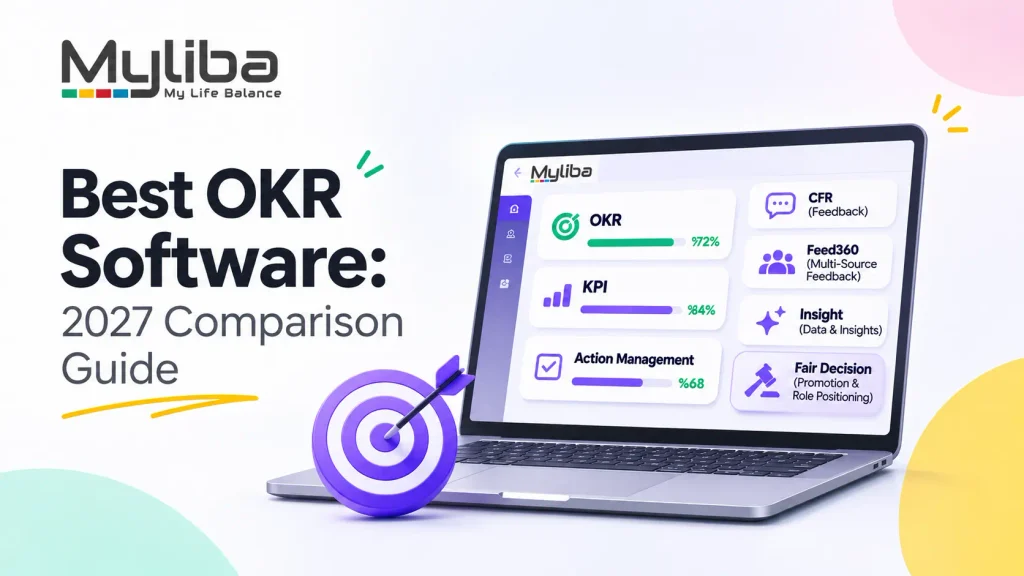
Myliba is an integrated platform that brings OKR and KPI management together with performance, employee development, and organizational culture processes.
In Myliba’s approach, performance is not evaluated solely through goal outcomes. KPI and OKR data are considered alongside behaviors, commitments, and ongoing dialogue processes.
The platform’s key modules and approaches include:
- OKR Management: Aligning and tracking company, team, and individual objectives.
- KPI Management: Monitoring organizational and individual performance indicators.
- Action Management: Tracking tasks and activities linked to objectives.
- CFR: Supporting Conversations, Feedback-Feedforward, and Recognition processes.
- Feed360: Managing multi-directional feedback processes.
- Insight: Analyzing organizational data and employee experience.
- Adil Karar (Fair Decision-Making): Bringing together KPI, OKR, behavior, commitment, and CFR data to support objective, transparent, and defensible promotion and role placement decisions.
Adil Karar: From Performance Data to Transparent Career Decisions
Promotion, role changes, and employee placement decisions should not rely solely on managers’ personal observations.
The Adil Karar approach within the Myliba Cultural Management Model addresses decision-making through four key data dimensions:
- KPI: What results have been achieved?
- OKR: Which objectives were pursued, and what progress was made?
- Behaviors and Commitments: How did the employee contribute, and how did they take responsibility?
- CFR: What insights emerged through ongoing conversations, feedforward, and recognition?
Considering these dimensions together helps organizations gain a more holistic understanding of employee contributions. The aim is to establish a more objective, transparent, and defensible basis for promotion and role placement decisions.
Myliba brings this approach together within a single platform for organizations looking to integrate goal management with performance, development, and organizational culture.
To discover an integrated approach that develops performance and culture, visit the Myliba software page.
Frequently Asked Questions
What is the best OKR software?
The best OKR software is the solution that best fits an organization’s goal management needs, organizational structure, workforce size, and budget. Goal alignment, KPI tracking, reporting, action management, and user experience should be evaluated together.
Can OKR software be used for free?
Some platforms offer free plans or trial versions. However, it is important to check the scope of features such as user limits, reporting, integrations, and access permissions.
Which companies can benefit from OKR software?
Small, medium-sized, and large organizations looking to implement the OKR methodology can benefit from OKR software. The scope of the platform should be determined according to the organization’s needs.
Can OKRs and KPIs be managed in the same software?
Yes. Some OKR platforms support both OKR and KPI tracking within the same system. This allows strategic objectives and ongoing performance indicators to be evaluated together.
Is OKR software the same as performance management software?
Not always. OKR software primarily focuses on managing objectives and Key Results. Performance management software may cover broader processes, including evaluations, feedback, competencies, and employee development. Some platforms bring both approaches together.
What is the most important criterion when choosing OKR software?
There is no single criterion that applies to every organization. However, strategic goal alignment, ease of use, consistent tracking, reporting, and compatibility with existing organizational processes are essential areas to evaluate.
How is fair decision-making related to OKR management?
OKR results can provide valuable information about employees’ contributions to organizational goals. However, decisions such as promotions and role changes should not be based solely on goal scores. A more holistic approach considers behaviors, commitments, feedback, and other forms of contribution together.
Conclusion: Turn Your Goals into Results in 2027
Choosing OKR software in 2027 is about more than tracking goals digitally. It is an important step in helping organizations translate strategy into everyday operations, bring teams together around shared priorities, and make performance development sustainable.
The right OKR management system supports goal visibility, measurable progress, a better understanding of employee contributions, and a stronger focus on shared outcomes.
When making your choice, consider not only the software’s features but also the kind of performance and working culture you want to build within your organization.
Myliba brings OKR and KPI management together with CFR, employee development, organizational insights, and the Adil Karar approach, offering a holistic perspective on performance and culture management.
Discover Myliba to turn your goals into results, your performance data into development opportunities, and your decision-making processes into more transparent practices.